The blower-door test


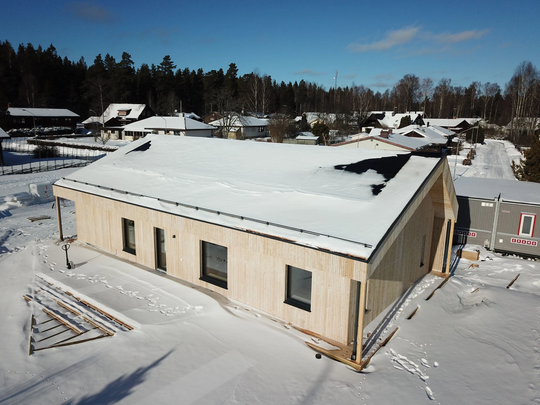
House owners who want to know whether their house is airtight and thus protected against mould, draught and high heating costs can have a differential pressure measurement, the so-called blower-door test, performed. It is a standard feature of low-energy and passive houses.
This test serves to find out how often the air volume changes in the rooms of the house per hour at a light over or low pressure. It is offered by power suppliers, building experts and craftsmen. The costs of a blower-door test vary from region to region (about 500 €/ about 1.000 CHF); but the investment pays off already after a short time, since a sealed house produces lower heating costs.
And this is how the blower-test works:
Film blower-door test
It is advisable to perform the measurement after professional sealing of the airtight layer and before installation of the interior cladding to facilitate the removal of defects.
For the measurement a strong blower in a frame provided with a foil is airtightly installed in an opened external door or window, while all other building openings are closed. Using the blower, which draws air out of the house or blows it in, a pressure difference of 50 Pascal between inside and outside is generated. The more air escapes through leakages to the outside when the increased inside pressure is reached, the more must the blower work and the higher is the air exchange rate (n50 value).
Limit values according to energy saving regulation:
for buildings with natural ventilation 3 per h
for buildings with ventilation system 1.5 per h
If leakages are evident or the permissible limit value is exceeded, it is important to find out where the leaks are. This can be done by means of air speed measuring instruments and thermographic cameras, but using fog and overpressure is the most impressive method. For this purpose the house is filled with artificial fog. The fog escapes from the building at the leaking points. In this way leakages can be localised and repaired.